
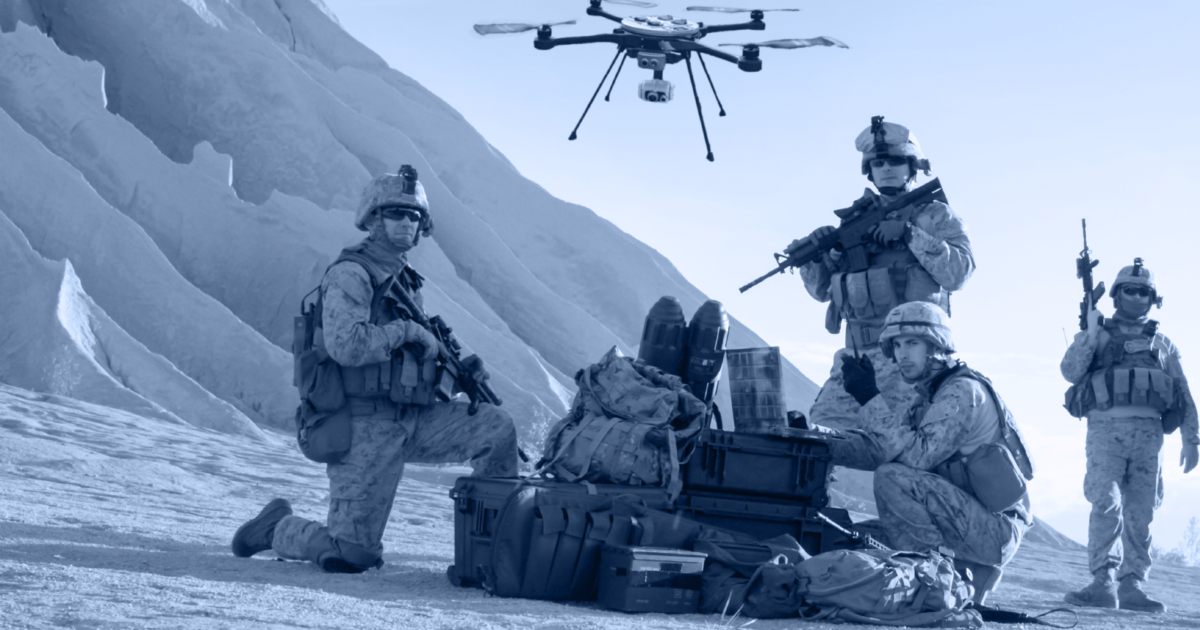
A drone launches ahead of an advancing unit. An unmanned ground vehicle pushes into contested terrain. At sea, an autonomous surface vessel maintains surveillance of a hostile coastline. None are connected by fixed infrastructure, yet all are exchanging command signals, video feeds, and sensor data in real-time.
As unmanned systems proliferate across every operational domain, the challenge of connecting them reliably has become one of the defining problems of modern defense. DTC has built its BluSDR™ unmanned communications portfolio around exactly that challenge, with a purpose-designed hardware platform, resilient and flexible MeshUltra™ mesh waveforms, and a manufacturing operation capable of scaling at the pace the market demands.
Built for Unmanned, Not Adapted for It
Most competitors entered the unmanned market by adapting products originally designed for dismounted soldiers or vehicle systems. The result is a compromise: hardware that is too heavy, too power-hungry, or too complex to integrate efficiently onto an unmanned platform.
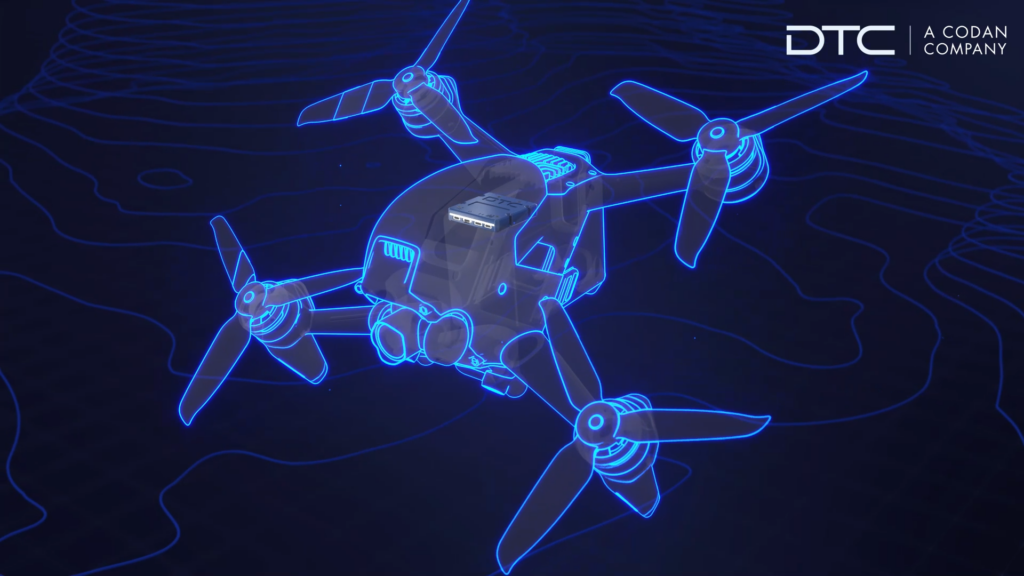
DTC took a different approach. The BluSDR™ Software Defined Radio platform was developed from the ground up with direct input from unmanned customers, purpose-built to meet the SWaP (Size, Weight, and Power) demands of unmanned applications.
“The introduction of the highly integrated BluSDR™ range of products has been critical in enabling DTC’s growth in Unmanned,” said Rob Garth, Vice President of Unmanned Systems at DTC. “These products offer outstanding SWaP performance and ease of customer integration, which makes them extremely attractive to unmanned platform manufacturers.”
That design philosophy extends to manufacturing. With production capabilities across three continents, full NDAA compliance, and a heavy investment in raw materials inventory, DTC delivers at scale and pace, while many competitors now quote lead times of six months or longer.
Mesh Connectivity Across Every Domain
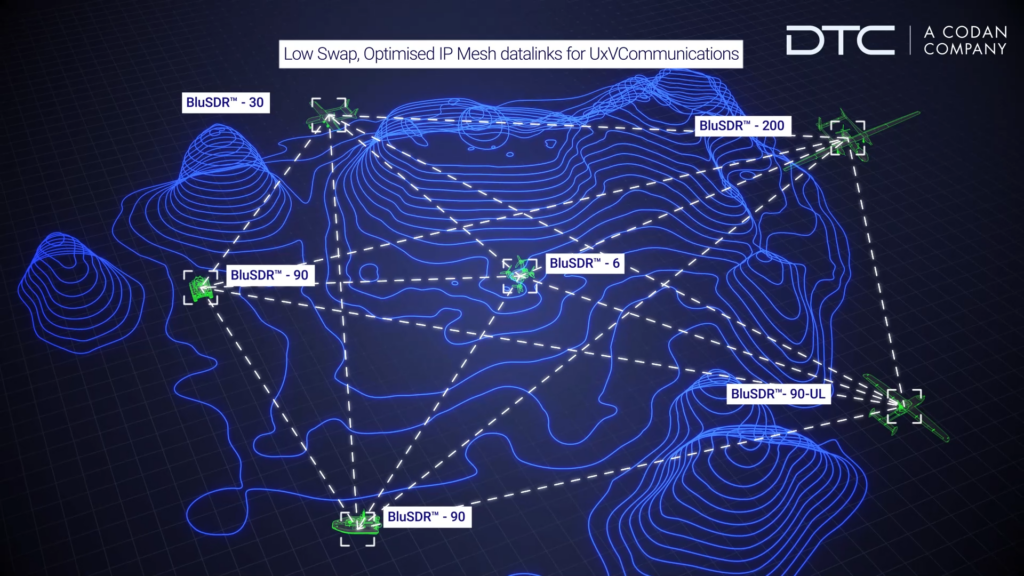
At the heart of DTC’s unmanned offering is the MeshUltra™ MANET Mesh waveform: a self-forming, self-healing network that automatically routes data by the most efficient available path. For unmanned systems, the architecture scales seamlessly from a single drone on a point-to-point link with its ground station, through multi-drone relay formations, to full swarm architectures, where every platform both transmits data and relays it on behalf of others.
DTC’s unmanned reach now extends across all three domains. In the air, BluSDR radios are widely deployed on military unmanned platforms. On the ground, the growing demand for unmanned ground vehicles and human-unmanned teaming applications is met by BluSDR in tandem with DTC’s Sentry Mesh range of soldier and vehicle communications products. At sea, USVs operating at sea level face inherently short line-of-sight distances. DTC addresses this challenge through multi-hop mesh relay architectures that extend operational reach well beyond what a single direct link could achieve, as well as offering an innovative alternative BVLOS (beyond visual line of sight) datalink capability based around extensive experience developing HF (High Frequency) communications systems.
Performing Where Traditional Systems Fail
Unmanned systems rarely operate in clean electromagnetic environments. The military spectrum is simultaneously contested by adversaries, i.e. deliberately jammed, and congested by the electromagnetic signatures of both friendly and adversarial forces as well as civilian communications systems and other sources of interference. GNSS jamming compounds the problem, denying platforms the positioning data they depend on.
“DTC’s MeshUltra™ waveforms are built for exactly these contested conditions,” said Garth. “Our Cognitive Interference Avoidance System (IAS) automatically reconfigures the network in response to jamming, maintaining connectivity without operator intervention.”
In GNSS-denied environments, DTC’s Radio Frequency (RF) ranging capability provides approximate positioning through multilateration, operating standalone or as part of a fused alternative navigation solution combining, for example, inertial sensing and terrain recognition.
Autonomy, AI, and Staying Connected
Most platforms today operate at relatively modest levels of autonomy, either under operator control or navigating to pre-programmed waypoints. Either way, a reliable communications link is essential for sending commands and receiving video and sensor data that give the mission its value. AI-enabled systems capable of greater autonomous operation are becoming more common, but even these require communications for retasking, status reporting, and operator override when needed, as well as – critically – delivering AI training data to support future missions.
Looking further ahead, AI is expected to shift mission planning and execution from prescriptive waypoint instruction toward broad goal assignment, with platforms determining detailed execution autonomously. The primary barriers are likely regulatory rather than technical. Questions of accountability and the appropriate role of human judgment in lethal decisions remain unresolved across the end user community globally.
DTC’s communications architecture is designed to scale with that evolution. As platforms move up the autonomy ladder, the network moves with them, providing reliable, low-latency connectivity that higher levels of autonomous operation will demand.

The Network that Follows the Mission
Every unmanned platform is a node that must communicate reliably and securely, even in environments designed to prevent it. DTC’s answer is a communications ecosystem built from the first principles for unmanned integration: purpose-designed hardware, resilient waveforms, robust anti-jam capability, GNSS-denied positioning support, and the engineering and manufacturing agility to keep pace with a rapidly evolving threat environment.
“We often hear that our team is easy to work with. We take an approach of listening more, talking less and going the extra mile to meet specific customer requirements,” said Garth. “But what makes us most proud is when we hear of DTC BluSDR™ and MeshUltra™ enabling our customers to deliver mission success in the most difficult environments where our competitors have tried and failed.”
In a domain where platform proliferation has outrun the communications infrastructure to support it, DTC is closing the gap. DTC provides what platform manufacturers and defense programs need most: communications that are purpose-built, proven under contested conditions, and ready to scale. When the mission demands absolute confidence in connectivity, DTC is the partner you can rely on.