
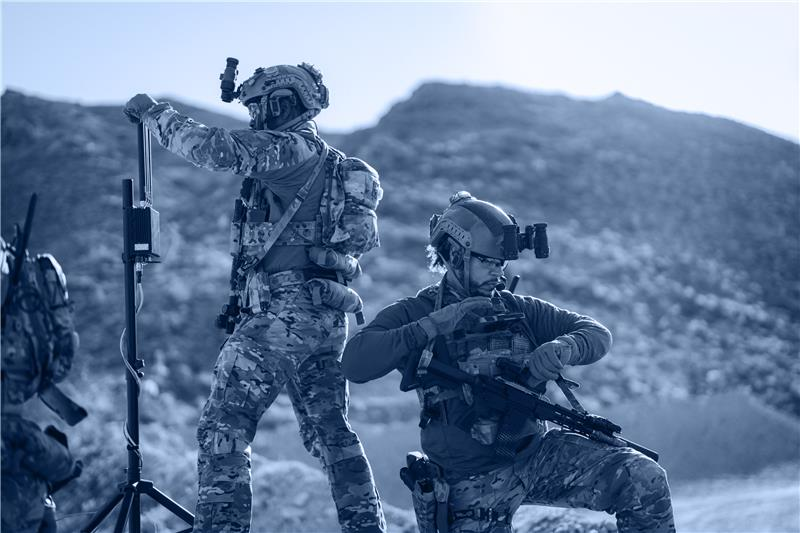
A small infantry unit presses through a contested urban environment. Buildings block the line-of-sight. Electronic warfare systems are actively jamming. Nodes drop in and out of range. In that environment, a communications network that depends on fixed infrastructure isn’t just unreliable; it’s a liability. DTC’s MESH Solution is built for exactly these conditions.
As forces become more distributed, mobile, and technologically dependent, the networks connecting them must be equally dynamic and resilient.
What is MESH?
DTC’s MESH Solution is a wireless communications architecture where every node — whether a radio, vehicle, soldier, drone, or sensor — connects directly to multiple other nodes simultaneously. This peer-to-peer architecture means that data, voice, and video can travel along multiple paths to reach their destinations.
“It’s about sending data to the next node or platform, and then that node communicates it on your behalf, and so on and so forth,” said Andrew Dobson, Vice President of Military Communications for DTC. “Think of it like stepping stones across a river. You don’t broadcast out and hope everybody is within range. Instead, the network finds its own path, one node at a time, all the way to its destination.”
MESH creates intelligent node-to-node connections using a token-based system, bringing discipline and order to the network. Each node passes information to the next, with the network continuously mapping the best path for data to travel. This creates a flexible, scalable network where distance limitations of individual radios are overcome by the collective reach of the network.

The Vulnerability of Traditional Networks
Traditional military and public safety communications have relied on infrastructure-dependent networks. Think of fixed base stations, centralized repeaters, or satellite links as the backbone. These work well in stable, predictable environments, but they carry a critical vulnerability: single points of failure. Destroy or jam the tower, the repeater, or the ground station, and the network collapses. In an era of sophisticated electronic warfare, that vulnerability is no longer acceptable.
DTC’s MESH Solution doesn’t just connect nodes. It actively adapts, reforms, and heals itself in real-time, ensuring that critical communications remain unbroken even in the most challenging environments.
Self-Forming and Self-Healing: Built to Expect Disruption
The defining features of DTC’s MESH Solution are the self-healing and self-forming capabilities, both built to expect and adapt to disruption from the outset.
Self-forming means the network automatically establishes itself. When radios power on, they broadcast their presence and recognize other nodes through the token-based system with matching credentials. The network forms organically, without manual configuration.
“Self-forming is having the network establish itself and broadcast ‘I’m here,’ and then other radios respond, ‘I’m here too. I have the same credentials.’ Just like that, the network forms,” said Dobson.
Self-healing takes this capability a step further. When disruption occurs, remaining nodes immediately recognize the gap and reform connections, finding alternative paths to keep data flowing.
“Self-healing is about maintaining the network as nodes pop in and out – whether that’s due to jamming, some form of interception, or simply being out of range. You want a network that continuously and dynamically changes. You want it to be intelligent,” said Dobson.
This recovery happens dynamically and continuously, with the network reshaping itself as conditions change. Crucially, reconvergence after a node loss occurs within seconds, minimizing disruption and keeping communications seamless to the operator even as the underlying network structure constantly shifts.
DTC’s system uses sophisticated protocols that allow nodes to maintain routing tables — essentially lists of who they’re connected to and the best paths to reach other nodes. When a connection breaks, these tables update rapidly.

Operational Applications
The flexibility and reliability of MESH networks make them ideal for environments where traditional infrastructure fails.
In urban environments, where buildings and obstacles constantly block line-of-sight communications, DTC’s MESH routes around obstacles using available nodes, ensuring personnel remain connected even in complex, cluttered terrain.
Unmanned Systems Integration: A Force Multiplier at Every Level
Perhaps the most operationally significant capability is the integration with unmanned systems. Operators equipped with MESH radios can now seamlessly connect to drones on the same network, enabling any node to view or control drone feeds in real time.
This fundamentally changes what a unit can do. Reconnaissance data can now flow directly into the MESH network, improving situational awareness and mission planning without adding complexity. The network treats an airborne platform as just another node; it simply adapts and reconnects as the UAV moves.
At a time when the lessons of recent conflicts are reshaping how nations approach unmanned systems integration, this capability represents a step change in what a networked force can achieve.

A Software-Defined, Open Architecture Approach
The reliability of DTC’s MESH Solution is also future-proofed by design. Rather than tying capability to hardware refresh cycles, DTC has embraced a software-defined architecture.
“Looking ahead, we’re going to keep developing and incrementally improving all the features, applications, and capabilities. But the base hardware will remain the same, giving customers longer use out of it. We’re moving away from a hardware-centric world,” said Dobson.
This model extends the useful life of hardware while ensuring users always have access to the latest capability improvements, delivered through software updates rather than costly procurement cycles. Investment is protected, and capability continues to grow, much like how smartphone apps evolve while the underlying device remains the same.
Mission Critical Communications
For the operators and commanders working in the world’s most demanding environments, a network that heals itself, adapts itself, and never stops working isn’t a luxury. It is the difference between mission success and mission failure.