
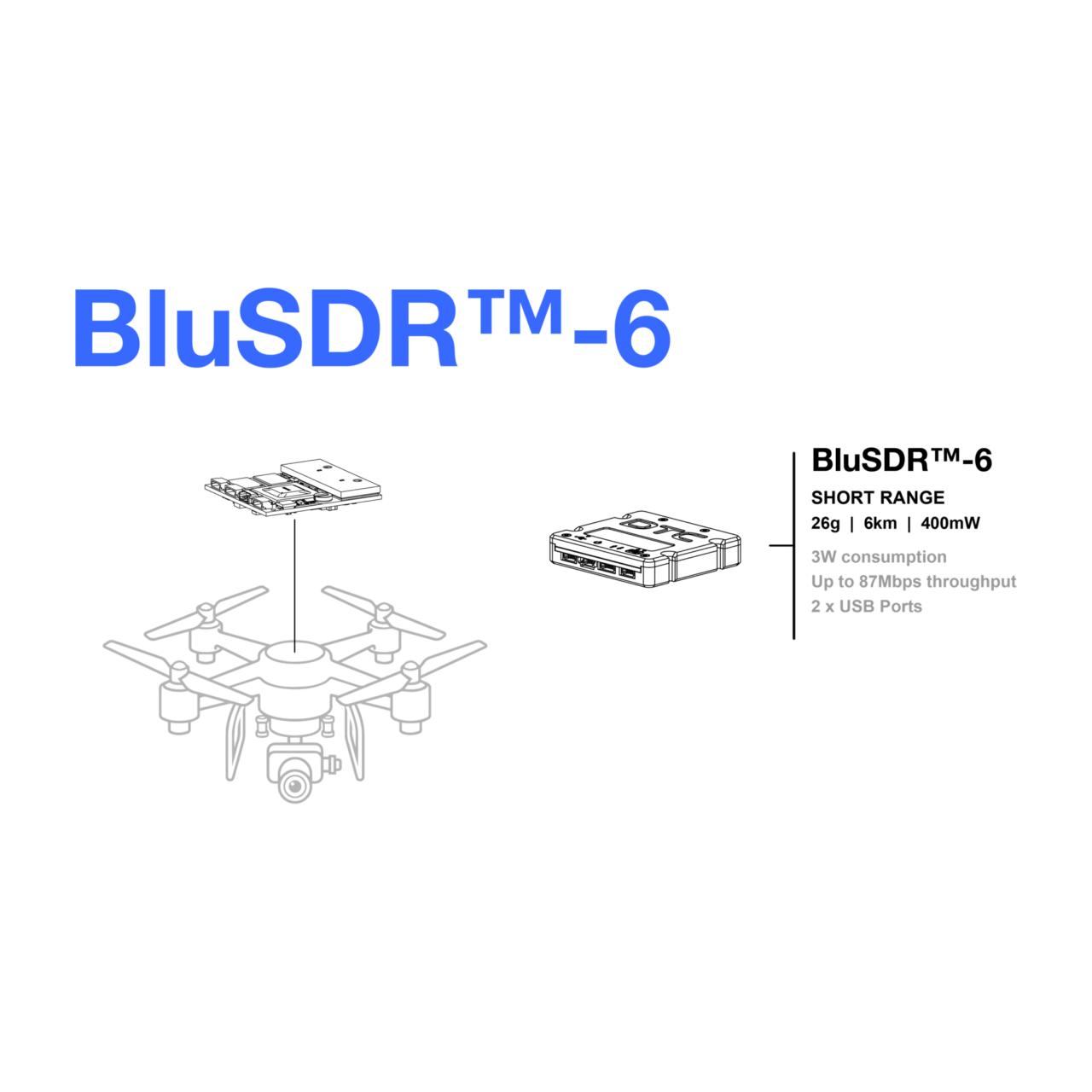
The BluSDR-6 is a size and weight critical, software defined radio module that delivers up to 400mW total output power across short-range UxV links up to 6km for small drone platforms.
Small drones need dependable communications without sacrificing payload, endurance, or airframe space. The BluSDR-6 is built around DTC’s SOL8SDR architecture in an ultra-compact module, with a core PCB weighing roughly 26 g. Dual COFDM transceivers, adaptive modulation, selectable bandwidths, and precise power control help integrators balance range, throughput, and power use for each mission.
A drone radio earns its place by what it connects. BluSDR-6 supports cameras, headsets, Wi-Fi, cellular, and Ethernet dongles through dual USB, with SBUS and MAVLink protocols for flight control integration. As a MANET radio, it forms a self-healing MeshUltra-X network of up to 144 nodes, allowing each airframe to originate, relay, and extend traffic across the mesh.
UxV links are tested by movement, interference, weak signals, and changing terrain. The BluSDR-6 uses adaptive carrier modulation, forward error correction, and self-healing mesh routing to maintain communications as conditions shift. Optional AES128/AES256 encryption, DES as standard, reverse polarity protection, and operation from -20°C to +50°C help keep small platforms connected in demanding RF environments.
Two COFDM transceivers deliver up to 400mW total output, frequency dependent, with 0.25dB incremental power control.
Optimised for short-range UxV links up to 6km on small drone platforms operating under tight SWaP limits.
MeshUltra-X MANET waveform forms a self-healing mesh of up to 144 nodes with capacity up to 87Mbps.
Core PCB measures 56mm x 48mm x 7.7mm at roughly 26g, with ultra-miniature connectors throughout.
Two USB ports support cameras, headsets, and dongles, with RNDIS Ethernet over USB to host devices.
Optional AES128 and AES256, accredited to FIPS140-2 for MeshUltra waveforms, with standard DES.
Internal microSD provides 128GB of onboard storage. SBUS and MAVLink protocols supported.
| Radio Architecture | SOL8SDR software defined radio |
|---|---|
| Mesh Waveform | DTC MeshUltra-X MANET IP Mesh, up to 144 nodes |
| Mesh Capacity | Up to 87Mbps MeshUltra |
| Protocols | SBUS and MAVLink supported |
| Host Connectivity | RNDIS Ethernet over USB; Wi-Fi, cellular, and Ethernet dongles |
| USB1 Control and Download | JST 5-way 1mm |
| USB2 Control and Download | JST 5-way 1mm |
| GPIO | JST 6-way 1mm |
| Power Input Connector | Molex 4-way 1.25mm |
| Encryption (standard) | DES |
| Encryption (licensed) | AES128/256, accredited to FIPS140-2 for MeshUltra waveforms (subject to export control) |
| Storage | Internal microSD 128GB |
| RF COFDM Transceiver 1 | MMCX (female 50 ohm) |
|---|---|
| RF COFDM Transceiver 2 | MMCX (female 50 ohm) |
| RF Power (frequency dependent) | 100mW (+20dBm) per output, 200mW total; or 200mW (+23dBm) per output, 400mW total |
| Power Step | 0.25dB incremental control |
| Tuning Step | 125kHz |
| Bandwidth | 1.25/1.5/1.75/2.5/3.0/3.5/4.0/5.0MHz (MeshUltra-M/-80/-X)6.0/7.0/8.0/10.0/12.0/14.0/16.0/20.0MHz (MeshUltra-M/-80) |
| Carrier Modulation | BPSK/QPSK/16QAM/64QAM (adaptive) |
| FEC Rate | FEC1/2, FEC2/3 (adaptive) |
| Receive Sensitivity | -98dBm (BW 2.5MHz/QPSK 1/2) |
| Receive Input Level | +20dBm max. |
| Frequency Options | 1.20 to 1.70GHz (2x100mW)1.67 to 2.35GHz (2x200mW)2.10 to 2.50GHz (2x200mW)4.20 to 5.20GHz (2x100mW) |
| Dimensions (core PCB) | 56mm x 48mm x 7.7mm (120170/167235/420520)50mm x 45mm x 7.7mm (210250) |
|---|---|
| Weight (core PCB) | 26g approx. (120170/167235/420520); 24g approx. (210250) |
| Dimensions (boxed) | 56mm x 54mm x 11mm (120170/167235/420520)50mm x 54mm x 11mm (210250) |
| Weight (boxed) | 62g approx. (120170/167235/420520); 60g approx. (210250) |
| DC Input | 6V to 18V, reverse polarity protected |
| Power Consumption (excluding cameras) | 3W typical (2x100mW); 4W typical (2x200mW) |
| Temperature Range | -20 to +50 °C with additional cooling |
| Humidity | Less than 85% non-condensing |
| Build Options | Core PCB or boxed module |
BluSDR-6 puts a full software defined radio on the smallest UxV platforms without forcing a SWaP compromise. Short-range missions up to 6km gain a self-healing tactical mesh network of up to 144 nodes, AES128 and AES256 encryption accredited to FIPS140-2, and dual USB integration for cameras and dongles. Low typical power draw of 4W also keeps endurance intact on battery-limited airframes. From small drone teams to single-platform reconnaissance, the BluSDR-6 holds the link in congested spectrum.